Sunday, May 25, 2014

2014 Geotechnical Symposium at UW

It had been twenty years since a Geotechnical Symposium for graduate students from universities in the Pacific North-West (PNW) was last organized.

The University of Washington (UW) was the host for the symposium 2014, which took place between the 8th and the 10th of May. The purpose was an exchange of ideas, research findings, and to professionally connect with other students and professors. The event consisted of a lecture and reception on Thursday evening, a whole day of presentations and poster sessions on Friday, and a field trip on Saturday to explore geohazards.

In this post, I am going to give some detailed information about the field trip itself. And in my next post, I will provide some detailed information about student research.

On Saturday, our group went to a field trip to the surrounding area of Seattle, WA to explore geohazards in the Seattle Fault Zone (SFZ). During our field trip, we listened to Thomas Doe, our geology guide for this day.
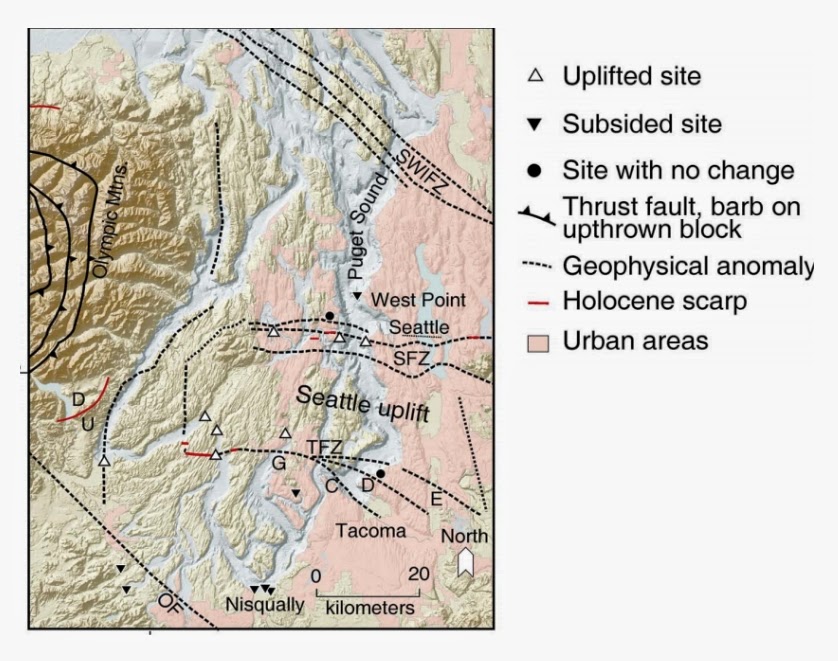
Craig Weaver and Brian Sherrod, USGS, Sound Shake '08

The Seattle Fault Zone is one of a series of major faults that cut across the Puget Sound basin. During an earthquake in 900-930 A.D., the Seattle Uplift occurred and resulted in an uplift of up to 9 yards or 8 meters. During our field trip we were able to stand exactly on top of the northern line of the uplift on a parking lot of the Eastside Christian Community Church. The whole uplifted area is indicated in the picture above. The field trip went on to Lake Sammamish east of Seattle, where the same earthquake, which caused the uplift, caused a still visible landslide.

Finally, we finished our tour at Cougar Mountain Regional Wildland Park. This park has a rich coal mining history. At first, we hiked on beautiful trails and over creeks to get to closed entrances to old coal mines. We discussed the hard work at first with mules, later with rails and oil lamps back in old times, and looked at the provided pictures on-site. The coal mining started in 1863 and went for 100 years. The mine worker tunneled up to 6 miles under the mountain to get the coal, which was then transported with Seattle's first railroad to a harbor and shipped to San Francisco. Most mines are multi-story, like underground apartment complex, leaving the ground above unstable and susceptible to sinkholes. Nowadays, the park is full of green leaves, trees, beautiful creeks, waterfalls and wild animals - nature took it back completely. But at the time of the coal mining, this same area was a big city of more than 600 homes, a rail line, hotels, stores, and churches. While hiking on trails through the forrest, one can still find pieces of coal, the mountain is made off.
Besides the historical importance of this huge park, for me, it is an astonishing beautiful landscape to hike.

The field trip ended with "goodbye's" and "hopefully till next year" comments and expressions. The success of this symposium could most likely result into an annual repetition of meetings in the PNW.


In my next post, I am going to give some detailed information about research of two graduate students and in addition, I will give an overview of results of the panel discussion about education at universities in the PNW.

Friday, May 16, 2014

Launch Post, the Second

Dear reader, welcome back to my blog.

After a year of silence, I am writing to you again.

A lot happened, not only in the world of underground structures, also in my personal life. I moved from Switzerland to Oregon, U.S.A. to pursue a PhD study in the field of geotechnical and earthquake engineering at the Oregon State University. More about how to apply for American universities, how to put yourself ahead in front of the all the other applicants, how to get to be known by well known professors, how to successfully get accepted at the universities of your choice, and other related topics like how to find a research topic for a PhD ..., more about all this in my upcoming articles later on.

But first, in my next posts, I am going to talk about the most recent events:
  • The Geotechnical Symposium at University of Washington (UW) in Seattle, WA, U.S.
  • Some intell about the Bonneville Dam and the Columbia River
  • Floating bridges in Seattle
  • A recently happened land slide in Oso, WA
  • The next upcoming event - the 10th U.S. National Conference on Earthquake Engineering in Anchorage, Alaska, in July - is getting some attention and posts from me, too.

I intend to post new articles every 10 to 14 days.

Forecast:
  • May 25th - General information about the Geotechnical Symposium at UW
  • June 5th - Presented topics at the Geotechnical Symposium at UW
  • June 15th - Bonneville Dam

I hope I got your interest in my next posts.

If there are topics you would like covered or if you are interested in special themes of the National Conference on Earthquake Engineering, who I should see, visit or talk to, please let me know in the comments.


Have fun reading and discovering my blog.

Stephie

Thursday, June 20, 2013

Presentation Techniques

At the World Tunnel Congress I got to sit in several presentations.
What I realized - please, don't understand me wrong, this is my opinion - I realized, that the presentations were good, full of information, facts and figures. However most of the speeches could be improved considerably. 

Therefore I want this post to be about presentation techniques.

It seems to me, if someone travels from far away to give a speech, they should be excited, and practice their speech, including the pronunciation in another language.

I think, the common engineer - including me - could improve their presentation skills. 
For me, I would ask myself some questions in advance / prior to create the presentation:
  1. What do I want to achieve with this? Why do I want to talk about it? What is it going to give me?
  2. Who is going to be my audience or who do I want to reach with it?
  3. Why should they care to listen to me?

The presenter has something valuable to give to the listener, so she/he should address them. Not only with the content, also with the body language. This means, that if you are giving a presentation, you should talk to the audience and connect with them. Many did not. They stayed in their own little bubble and some just read their slides out loud without even looking at the audience. Boring!

The best speeches I heard during the congress, were the ones, where the speaker looked at me from time to time, spoke loud and slow enough to be followed in another language, showed emotions like engagement and interest in the topic.

I know, sometimes it is hard to stand in front of a big group - at least for me. But they just want to listen to you and hear about your work to get new input of information and new ideas.

What helps me to improve myself, is to ask a colleague for honest feedback. I had to learn not to feel offended by my colleagues and friends. They don't want to harm me, they want to help me and I asked them to do so.

I am not a presentation coach. But I want to give you my personal summarized feedback of the speeches I heard. 

I hope it will help for your next presentation.

Please, feel free to give me a feedback on this topic - good or what could be different or improved. I will be happy to listen to you.

What presentation resources can you recommend to us such as books, web sites, blogs, methods that could help us give better presentations?

Wednesday, June 12, 2013

World Tunnel Congress - Choice of Tunneling Method

I consider myself lucky that the World Tunnel Congress was in the country I live in.  Geneva is a beautiful city next to Lake Geneva (lac léman) in the south-west corner of the french part of Switzerland.

This meeting was just like all such meetings - full of excitement, business talks, a chance to see and be seen by colleagues from around the world, and to sit in on case study presentations.
The sessions, presentations, case studies and technical themes took place at the same time. So I could pick out what I wanted to see, and when to take a look around the exhibitions and talk to the exhibitors about their news, in which projects they are interested in and involved. 

My first step on Tuesday was to eat some lunch, meet my colleagues and go into the swiss sessions first. The theme of the swiss colloquium was the "choice of tunneling method".

At the beginning of a project, one of the main questions is how to go through the rock, how to excavate: drill and blast, with a tunnel boring machine (TBM), with or without a pilot tunnel, conventional excavation without blasting and how to excavate all the secondary elements like cross sections and niches.

The speakers talked about their chosen method, pros and cons, problems that occurred, the problem solving and suggestions which excavation methods could be applied in this situation too.

Here I will give you a summary of one speech:

The choice of driving method in soft ground - the Längholztunnel. This tunnel is situated in the western part of Switzerland in Biel / Bienne, not far from Berne, the capital of Switzerland. The tunnel goes through soft ground with a groundwater level of 3 to 10 m (9 to 33 feet) above the tunnel crown. First step, they did a risk analysis to figure out what kind of excavation method was appropriate for this kind of soft soil. After the first risk analysis they chose a Hydro-shield TBM out of EPB (earth pressure balance) TBM, compressed-air shield and conventional drive. The general analysis points were the standard cross-section, tunnel length, geology, overburden, close buildings and obstacles underground. The aspects for choosing the driving method were the evaluation of the ground conditions, process technology and budget considerations, surface settlements and reduction of time consuming measurements to improve the ground.

After taking a deeper look at the ground conditions, analyzing different tunnel cross-sections in soft ground - the project developer came to the interpretation, that an EPB drive was a better solution for the anticipated ground conditions.

The big advantage of an EPB shield is that a sudden intrusion into the extraction chamber isn't feasible with regard to the supported face. Also working conditions are better in terms of excavation noise. Among other advantages and disadvantages - like the difficulties with the earth pressure adjustments or the time it takes to enter the working area.  For reasons, the chosen excavation method was to go with EPB. Some criteria for the decision were the economy, face stability, cave-ins, dealing with boulders and blocks and the dumping capacity of the installation area.

The point of the speech was, that an enlarged and systematical risk analysis with detailed case scenarios and additional explorations of the geological conditions could result in a different driving method and should be considered in cases, in which the choice between similar kinds of driving methods are to be taken.


Thursday, May 30, 2013

World Tunnel Congress 2013

Dear reader,

The World Tunnel Congress is coming up soon.

The main themes on Tuesday, 4th of July will be:

  • The Open Session with the main focus on Global Perspectives
  •  The ITAtech Innovation Session with reports on the Activity Groups about tunnel boring machines, lining, waterproofing and monitoring
  • The Swiss session with the topic "Choice of Tunnelling Method"
  • The technical sessions with the attention on construction technology developments and case histories
  • The ITA COSUF with safety challenges and solutions

The main themes on Wednesday, 5th of July will be:
  • The Swiss session with the main topic "Gotthard Base Tunnel" - planning, challenges, innovations and contract management
  • The young Swiss tunnellers with reports about squeezing conditions and face stability issues
  • The technical sessions with focus on project planning, design and analysis methods, more construction technology developments and case histories

For further information: world tunnel congress 2013

If you are interested in special themes of the World Tunnel Congress 2013, or who I should see, visit or talk to, please let me know in the comments.

I hope you have fun exploring the underground like I do.


Sunday, May 26, 2013

Tunnelling in Switzerland

The country Switzerland is situated in the heart of Europe. It is a connecting point for the European traffic lines (TEN).

Switzerland is composed of 60% of the Alps. Therefore it is natural to build tunnels and use the underground space for environmental and energy matters like hydro power plants. This post deals with the big traffic lines through Switzerland.

The two main connections of the Genoa - Amsterdam axis are the Gotthard Base Tunnel and the Loetschberg Base Tunnel. Those tunnels are built to reduce the heavy goods transports on the roads and to put them on the rails.


Location of the Loetschberg and Gotthard Base Tunnel (http://mycoordinates.org/)

Basic Information about the Gotthard Base Tunnel:
  • 57 km long (35.4 miles)
  • 2 single-track tubes
  • Excavation of 2/3rd with TBM, 1/3rd with drill and blast
  • opening to the traffic: end of 2016
  • in combination with Ceneri base tunnel (15 km / 9.3 miles long, open to traffic End of 2019)
  • total costs 18.7 billion CHF (19.3 billion USD) (1998)

Basic Information about the Loetschberg Base Tunnel:
  • 34.6 km long (21.5 miles)
  • 2 single-track tubes
  • Excavation with drill and blast
  • opening to the traffic: 2007
  • total costs 4.3 billion CHF (4.4 billion USD)


Wednesday, May 15, 2013

Why World Tunnel Congress

The World Tunnel Congress is an annual General Assembly of the International Tunnelling and Underground Space Association (ITA).

The ITA was founded in 1974 by a group of nineteen nations. At the moment the association is comprised of 64 member nations. The aims of the ITA are:
  • to support the people, the cities, the increasing flow of individuals (traffic) and the environment by strengthening the use of the underground space e.g. tunnels
  • to support a sustainable development of underground structures,
  • to gather and promote advancements in planning, design, technology, construction, safety, and maintenance of underground structures and spaces, and
  • to scrutinize issues and study questions about related themes.

To resolve the questions, the ITA formed various committees for different areas in the field of underground structures and spaces:


    • ITA-COSUF
      • Committee on Operational Safety of Underground Facilities
      • To deal with operational safety and security of underground facilities
    • ITA-CUS
      • Committee on Underground Space
      • Discussions of topics about the "strategic importance for underground space use and tunnelling"
    • ITA-CET
      • Committee on Education and Training
      • Creation of training sections, coordination of interactions and exchanges of know-how
    • ITA tech
      • Committee on technologies
      • Several Activity Groups discuss technical questions to improve new technology and their use

    The annual World Tunnel Congress is a place for exchange of knowledge regarding underground topics as well as cultural aspects of each host nation. 
    This years meeting will be held in Geneva, Switzerland. For the year 2014 the host nation will be Brazil (Iguassu) and in 2015 it will be Croatia (Dubrovnik).